
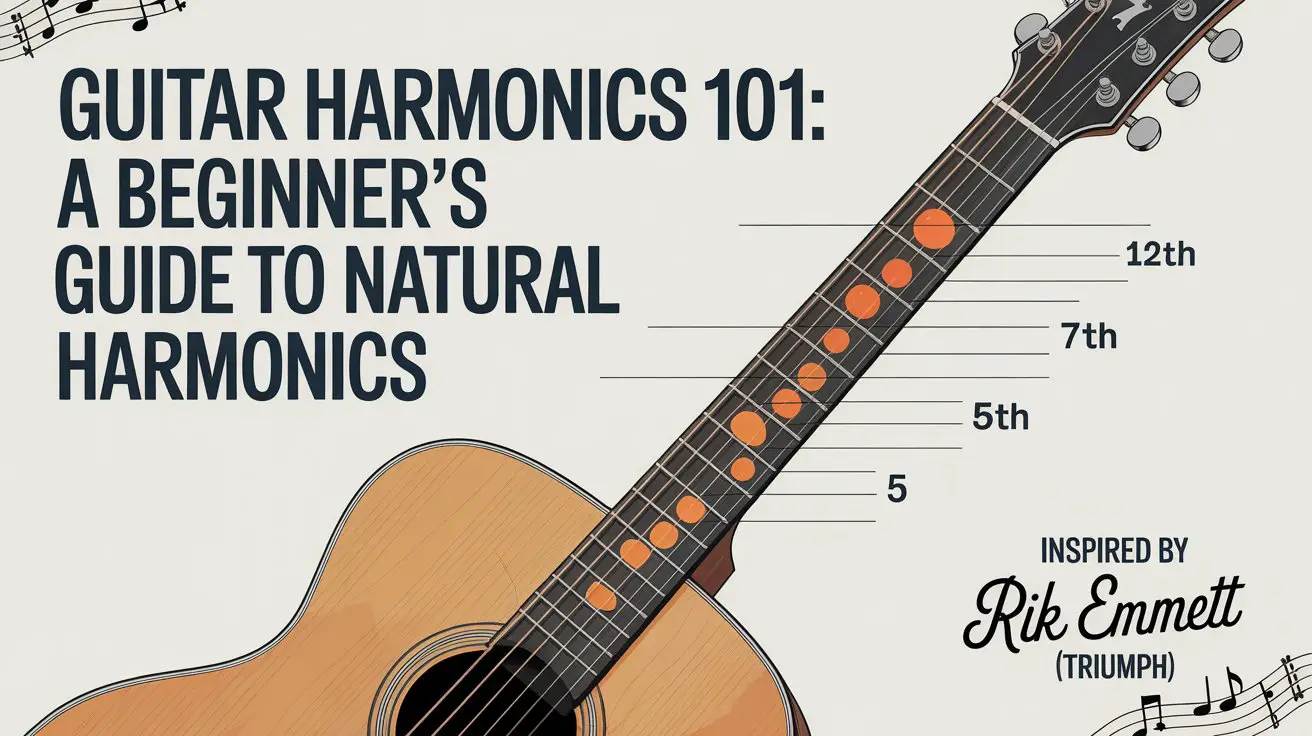
Inspired by “Midsummer’s Daydream” by Rik Emmett (Triumph)
Guitar harmonics are one of the most beautiful and expressive techniques you can learn as a guitarist. They create bell-like, chimey tones that instantly elevate your playing and add a professional touch to intros, solos, and ambient passages.
If you have listened to “Midsummer’s Daydream” by Rik Emmett or classic Eddie Van Halen recordings, you have already heard how musical and powerful natural harmonics can be.
If you are new to the instrument, these techniques will make more sense when combined with our beginner guitar lessons.

In this beginner-friendly guide, you will learn:
- What guitar harmonics are and how they work
- How to play natural harmonics correctly
- Common harmonic positions on the fretboard
- Easy harmonic exercises written in guitar tab form
This lesson focuses entirely on natural harmonics, making it perfect for beginners.
What Are Guitar Harmonics?
Guitar harmonics are sounds produced by isolating specific vibration points, called nodes, on a vibrating string. These nodes occur at precise mathematical divisions of the string length and relate directly to the open-string pitch.
Instead of pressing the string down, you lightly touch it at these points to allow only part of the vibration to ring out. The result is a clear, bell-like tone. pitch) and occur at precise mathematical divisions of the string length.
How to Play Natural Harmonics on Guitar
Natural harmonics are created by following these steps:
- Play an open string
- Lightly touch the string with your fretting hand
- Touch the string directly above the fret wire
- Do not press the string down
- Pluck the string normally with your picking hand
- Remove your fretting finger immediately after plucking
The most common harmonic positions are:
- 12th fret (octave harmonic)
- 7th fret
- 5th fret
These fret positions are where beginners should start.
Key Technique Tips for Clean Harmonics
This section is critical if you want your harmonics to ring clearly.
- Always start with an open string
- Touch directly above the fret wire, not the middle of the fret
- Use zero pressure on the string
- Lift your finger immediately after plucking
- If the harmonic does not ring, use a lighter touch
Clean harmonics rely heavily on proper guitar finger placement and a relaxed touch.
Important reminder:
Lightly means lightly. This is the number one mistake beginners make.
Guitar Harmonic Notation Guide
If tablature looks confusing, review our guide on how to read guitar tabs before starting the exercises below.
Before starting the exercises, here is how harmonics are written in tablature:
- 0 = Open string
- (5), (7), (12) = Harmonic touched at that fret
- xxxxx = Do not play that string
Exercise 1: 12th Fret Octave Harmonics
These are the easiest and most commonly used harmonics.
---------------------------------
---------------------------------
---------------------------------
-------------------0-(12)--------
---------0-(12)------------------
0-(12)---------------------------

Exercise 1 Continued
----------------------0-(12)--
------------0-(12)------------
--0-(12)----------------------
--------xxxxxxxxxxxxxxxx
--------xxxxxxxxxxxxxxxx
-xxxxxxxxxxxxxxxxxxxxxx
Practice slowly and focus on producing a clear, ringing tone.
Exercise 2: 5th Fret Harmonics
The 5th fret harmonics sound brighter and are slightly harder to control.
--------------------------
--------------------------
--------------------------
-----------------0-(5)----
---------0-(5)------------
-0-(5)--------------------

Exercise 2 Continued
-----------------0-(5)----
---------0-(5)------------
-0-(5)--------------------
-----xxxxxxxxxxxxxx
--------xxxxxxxxxxx
-------xxxxxxxxxxxx
Exercise 3: 7th Fret Harmonics
The 7th fret harmonic sits between the 5th and 12th fret in both tone and difficulty.
--------------------------
--------------------------
--------------------------
-----------------0-(7)----
---------0-(7)------------
-0-(7)--------------------

Exercise 3 Continued
-----------------0-(7)---
---------0-(7)-----------
-0-(7)-------------------
-xxxxxxxxxxxxxxx
-xxxxxxxxxxxxxxx
-xxxxxxxxxxxxxxx
Exercise 4: Mixed Harmonic Positions
This exercise trains your ear to recognize different harmonic tones.
--------------------------
--------------------------
--------------------------
-----------------0-(12)---
---------0-(7)------------
-0-(5)--------------------

Exercise 4 Continued
-----------------0-(12)
---------0-(7)---------
-0-(5)-----------------
-xxxxxxxxxxxxxx
-xxxxxxxxxxxxxx
-xxxxxxxxxxxxxx
Exercise 5: Multiple Harmonics on One String
This exercise improves timing, coordination, and accuracy.
------------------------------
------------------------------
------------------------------
------------------------------
------------------------------
----------------0-(5)-(12)----
-0-(5)-(12)-------------------

Exercise 5 Continued
-----------------------0-(12)
----------------0-(5)---------
--------0-(7)---------------
-0-(5)----------------------
-xxxxxxxxxxxxxxxxx
-xxxxxxxxxxxxxxxxx
Musical Reference: “Midsummer’s Daydream” Intro
To hear natural harmonics used musically and tastefully, study the intro to “Midsummer’s Daydream” by Rik Emmett of Triumph. This piece is an excellent real-world example of how harmonics can be melodic, expressive, and emotional rather than just technical.
🎧 Watch here:
Final Thoughts
Natural harmonics are a crucial guitar technique that every player should learn early. Practicing harmonics improves:
- Tone control
- Touch sensitivity
- Musical expression
- Overall fretboard awareness
Take your time with each exercise, focus on accuracy, and listen carefully to the sound you are producing. Once you master harmonics, they become incredibly fun and addictive to play.
Happy practicing !!

🎸 Enjoying GuitarTwitt?
Join 2,000+ guitarists getting free chord sheets and guitar tips every week.
+ Get our Top 20 Easy English Songs Chord Book free today.
🔒 No spam. Unsubscribe anytime.