
You’ve just bought your first guitar, opened a chord chart, and… what are you even looking at? A grid with dots and X’s that looks more like a puzzle than music. Don’t worry — every guitarist alive has been exactly where you are right now.
A chord diagram (also called a chord box or chord chart) is simply a visual map of where to put your fingers on the guitar neck. Once you understand the 5 basic symbols, you’ll be able to read any chord diagram on the internet in seconds. Let’s break it down.
The 6 Vertical Lines = Your 6 Guitar Strings
Imagine holding your guitar upright in front of you, with the headstock pointing up. That’s exactly what a chord diagram looks like. The 6 vertical lines represent your 6 strings:
String Layout (Left to Right)
E A D G B e
(thickest) ← → (thinnest)
6th 5th 4th 3rd 2nd 1st
The leftmost line is your thickest string (low E, the 6th string), and the rightmost line is your thinnest string (high e, the 1st string). This mirrors what you see when you look straight at your guitar’s fretboard.
The Horizontal Lines = Frets
The horizontal lines running across the diagram represent the metal frets on your guitar neck. The very top thick line is the nut — that white or bone piece at the very top of your guitar neck where the strings rest before reaching the tuning pegs.
The space between two horizontal lines is where you press your finger. So when we say “place your finger on the 2nd fret,” we mean press down in the space between the 1st and 2nd fret wire.
The 5 Symbols You Need to Know
Every chord diagram uses the same 5 symbols. Learn these once and you’ll never be confused again:
Black Dot = Press Here
Place your fingertip on this exact string and fret. Press down firmly right behind the fret wire (not directly on it).
Open Circle (O) = Play This String Open
Strum this string, but don’t press any fret. Let it ring freely.
X = Don’t Play This String
Mute this string or simply avoid strumming it. This is the most commonly ignored symbol by beginners — but it makes a huge difference in how clean your chord sounds.
Numbers Inside Dots = Finger Numbers
1 = Index finger, 2 = Middle finger, 3 = Ring finger, 4 = Pinky. Your thumb is not numbered — it stays behind the neck.
Fret Number = Starting Position
If a number like “3fr” appears on the side, it means the diagram starts at the 3rd fret instead of the nut. This is common for barre chords played higher up the neck.
Let’s Read Your First Chord: C Major
Time to put this knowledge to work. The C Major chord is one of the first chords every guitarist learns. Below is the actual chord box diagram with annotations — this is what you’ll see in guitar books, apps, and on most websites:
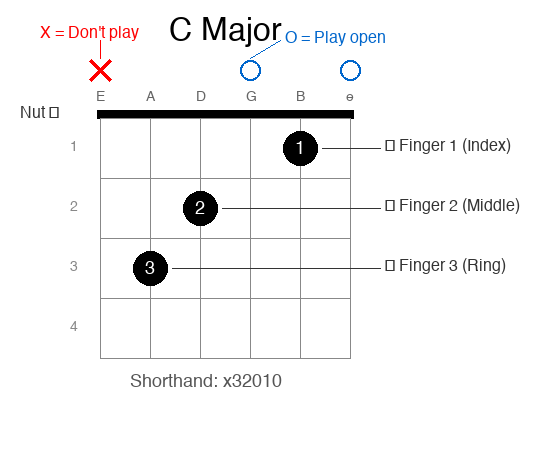
How to read this diagram:
- The X above the low E string = don’t strum this string
- The O above G and high e strings = play these strings open (no finger pressing)
- Finger 1 (Index) on the B string, 1st fret
- Finger 2 (Middle) on the D string, 2nd fret
- Finger 3 (Ring) on the A string, 3rd fret
- The thick line at the top is the nut — the bone/plastic piece at the very top of your guitar neck
- The numbers on the left (1, 2, 3, 4) are fret numbers
The number shorthand for this chord is x32010 — which reads: skip 6th string, 3rd fret on A, 2nd fret on D, open G, 1st fret on B, open high e.
See? The diagram is just a picture of your guitar neck. The dots tell you where your fingers go. That’s it.
5 Essential Beginner Chords — Reference Diagrams
Now that you know how to read a chord diagram, here are the 5 most important chords every beginner needs to learn. If you master these 5 shapes, you can play thousands of songs — from Bollywood to English pop:
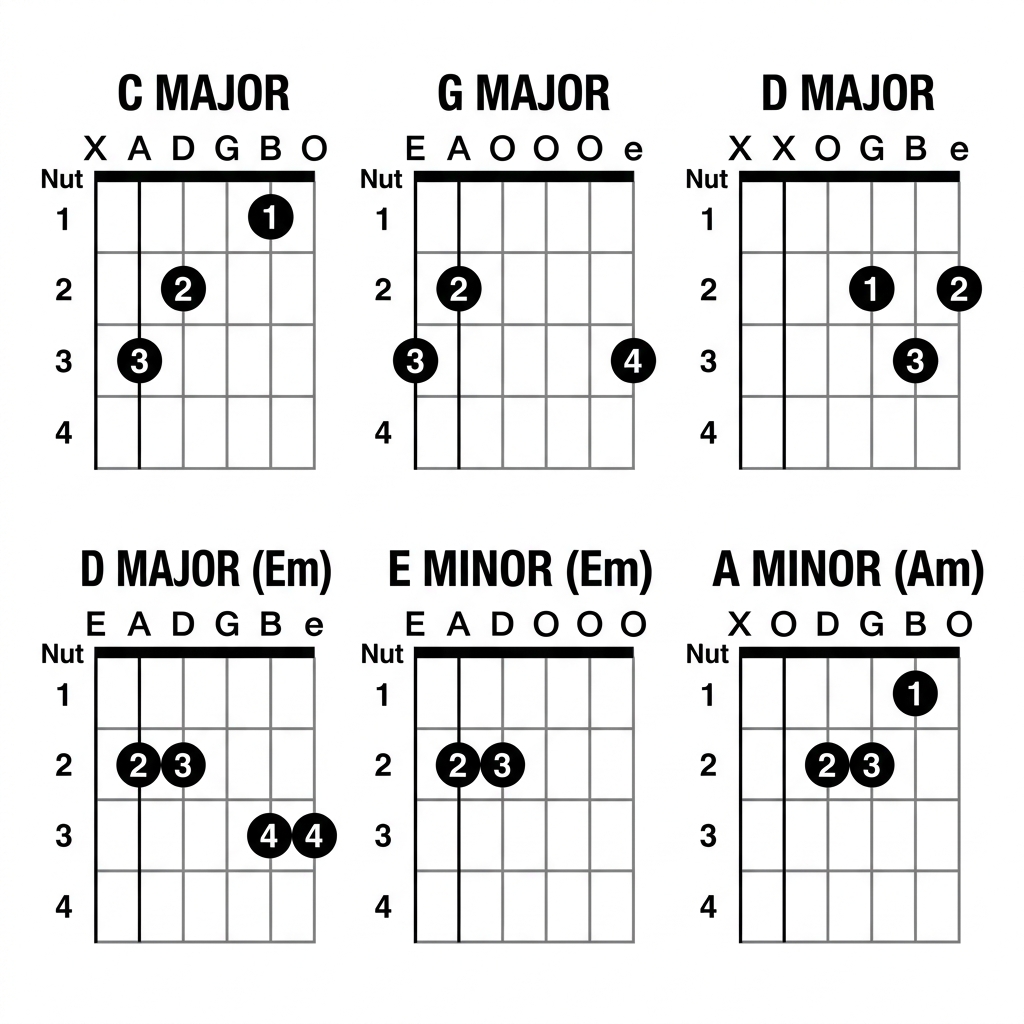
Practice reading each diagram using the skills you just learned: find the X’s and O’s at the top, locate the black dots on the grid, and place your numbered fingers on the correct string and fret. Start with Em (the easiest — just 2 fingers!) and work your way up to C and G.
💡 Try It Yourself
Open any chord page on GuitarTwitt — like Pani Da Rang or Give Me Some Sunshine — and look at the Chord Shapes section. You’ll see the exact same diagram format you just learned to read!
🎸 Just Getting Started? Here’s the Guitar We Recommend
If you’re a complete beginner in India, the Yamaha F310 is hands-down the best guitar to learn on. It’s affordable, the neck is comfortable for small hands, and it stays in tune — which is half the battle when you’re starting out.
Check Price on Amazon India →What Does “x32010” Mean? (The Number System)
On many websites (including GuitarTwitt), you’ll see chords written as a string of numbers like x32010 instead of a visual diagram. This is just a shorthand:
- Each number represents one string, from the thickest (6th) to the thinnest (1st)
- 0 = play that string open (no finger pressing)
- x = don’t play that string at all
- Any other number = press that fret on that string
So x32010 (C major) reads as: skip the 6th string, press the 3rd fret on A, 2nd fret on D, open G, 1st fret on B, open high e. Once you get used to this system, you can read any chord instantly without needing a picture.
Common Mistakes Beginners Make
After teaching hundreds of students, these are the 4 mistakes I see every single week:
- Pressing on the fret wire instead of behind it. Your finger should sit just behind the metal fret — not directly on top of it. Pressing on the wire creates a buzzing sound.
- Ignoring the X symbol. When a chord says “don’t play the 6th string,” you need to actually mute it or avoid it. Strumming muted strings makes your chord sound muddy and amateur.
- Using the flat part of the finger. Press with your fingertip, not the pad. Curl your fingers like you’re holding a tennis ball. If your fingers are flat, they’ll accidentally touch neighboring strings and mute them.
- Not pressing hard enough. New guitarists are afraid of hurting their fingers. Yes, it will hurt for the first 2 weeks — but then you develop calluses and it stops. Push through it.
Practice These Songs Next
Now that you can read chord diagrams, it’s time to use them! Here are some songs from GuitarTwitt that only use the basic chords you just learned:
🎵 Start Playing These Songs
Q: What do the dots mean on a guitar chord diagram?
The black dots on a chord diagram show you exactly where to place your fingers. Each dot sits on a specific string and fret intersection. The number inside the dot (if present) tells you which finger to use: 1 = index, 2 = middle, 3 = ring, 4 = pinky.
Q: What do the X and O symbols mean on chord charts?
An X above a string means do not play that string — either mute it with a finger or avoid strumming it. An O (open circle) means play the string open without pressing any fret.
Q: What is the easiest guitar chord for beginners?
E minor (Em) is widely considered the easiest guitar chord. It requires only two fingers — middle finger on the 2nd fret of the A string and ring finger on the 2nd fret of the D string. All 6 strings are strummed.
Q: How do I read chord numbers like x32010?
Each number represents one string from the 6th (thickest) to the 1st (thinnest). 0 means play the string open, x means don’t play it, and any other number tells you which fret to press. So x32010 (C major) means: skip 6th string, 3rd fret on A, 2nd fret on D, open G, 1st fret on B, open high e.
Q: Why does my chord sound buzzy?
The most common cause is pressing directly on top of the fret wire instead of just behind it. Your fingertip should be placed in the space between two frets, close to the fret wire but not on it. Also make sure you’re pressing with your fingertip (curled fingers), not the flat pad of your finger.
If you like the work, please write down your experience in the comment section, or if you have any suggestions or corrections, please let us know in the comment section.
🎸 Enjoying GuitarTwitt?
Join 2,000+ guitarists getting free chord sheets and guitar tips every week.
+ Get our Top 20 Easy English Songs Chord Book free today.
🔒 No spam. Unsubscribe anytime.
3 thoughts on “How to Read Guitar Chord Diagrams – A Complete Beginner Guide”
Comments are closed.