
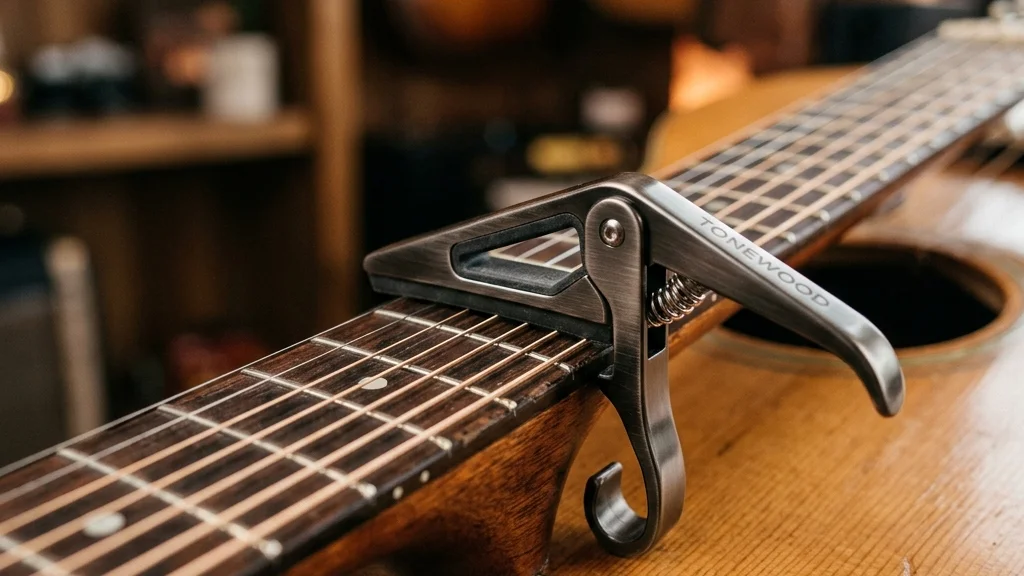
You’ve seen it on every acoustic guitarist’s guitar — a small clamp attached to the neck. It looks simple. But that little device is one of the most powerful tools a guitarist can own.
A capo (pronounced KAY-poh) lets you change the key of a song without learning new chord shapes. With the 5 open chords you already know, a capo gives you access to every key on the guitar.
This guide covers everything: how it works, when to use one, the transposition chart, and which capo to buy.
What Does a Capo Actually Do?
A capo clamps across all 6 strings at a specific fret, effectively creating a new “nut” (the white piece at the top of the fretboard). This raises the pitch of every string equally.
The Simple Version
Imagine cutting your guitar’s fretboard shorter. That’s what a capo does. Everything shifts up.
- Capo on Fret 1 → everything shifts up by 1 semitone (half step)
- Capo on Fret 2 → everything shifts up by 2 semitones (1 whole step)
- Capo on Fret 5 → everything shifts up by 5 semitones
What This Means in Practice
If you place a capo on the 2nd fret and play a “G shape,” you’re actually playing an A major chord. The shape is the same — your fingers don’t change — but the sound is different.
This is incredibly useful when:
- A song is written in a difficult key (like Ab or Eb)
- You want to avoid barre chords
- You need to match a singer’s vocal range
- You want to play along with a recording that’s in a different key
How to Use a Capo — Step by Step
Step 1: Tune Your Guitar First
Always tune before placing the capo. Putting on a capo slightly changes string tension, so starting in tune ensures the best results.
Step 2: Position the Capo
Place the capo just behind the fret wire of the desired fret — not on top of it, and not too far behind it. Think of it like your finger: the same spot where you’d press to fret a note cleanly.
For example, if the song says “Capo 2,” place the capo behind the 2nd fret wire.
Step 3: Check for Even Pressure
Make sure the capo is:
- Straight across all 6 strings (not tilted)
- Tight enough to press all strings cleanly (no buzzing)
- Not too tight — over-clamping can bend notes sharp
Step 4: Quick Tuning Check
After placing the capo, strum a few chords. The capo can pull strings slightly sharp, especially on cheaper capos. If anything sounds off, do a quick retune with the capo on.
Step 5: Play as Normal
Now play your chord shapes exactly as you would without a capo. Your fingers operate relative to the capo — the capo IS your new “fret 0.”
The Capo Transposition Chart
This is the most useful reference you’ll ever need. It shows what actual key you’re playing when you use a specific capo position with common chord shapes.
If You Play a G Shape:
| Capo Fret | Actual Key |
|---|---|
| 0 (no capo) | G |
| 1 | Ab / G# |
| 2 | A |
| 3 | Bb / A# |
| 4 | B |
| 5 | C |
| 7 | D |
If You Play a C Shape:
| Capo Fret | Actual Key |
|---|---|
| 0 (no capo) | C |
| 1 | Db / C# |
| 2 | D |
| 3 | Eb / D# |
| 4 | E |
| 5 | F |
| 7 | G |
If You Play a D Shape:
| Capo Fret | Actual Key |
|---|---|
| 0 (no capo) | D |
| 1 | Eb / D# |
| 2 | E |
| 3 | F |
| 4 | F# / Gb |
| 5 | G |
| 7 | A |
If You Play an Am Shape:
| Capo Fret | Actual Key |
|---|---|
| 0 (no capo) | Am |
| 1 | Bbm / A#m |
| 2 | Bm |
| 3 | Cm |
| 4 | C#m / Dbm |
| 5 | Dm |
| 7 | Em |
Pro Tip: You don’t need to memorize this chart. Bookmark it and refer back whenever you need to transpose a song.
When Should You Use a Capo?
1. To Avoid Barre Chords
Playing in the key of F? That requires an F barre chord, which is one of the hardest things for beginners. Instead: Capo 1, play E shapes. Same key, zero barre chords.
2. To Match a Singer’s Voice
If a song is in the key of A but the singer’s range fits better in B, just move the capo to the 2nd fret and play the same shapes.
3. To Play Along With a Recording
Many songs are recorded with capos. If you see “Capo 4” on a chord sheet, it means the original recording uses a capo on the 4th fret. Without the capo, you’d play the right shapes but in the wrong key.
4. For a Brighter Sound
Higher capo positions give a brighter, chimier tone — great for fingerpicking and arpeggios. Many Ed Sheeran, Taylor Swift, and Coldplay songs use capos for this exact reason.
When Should You NOT Use a Capo?
- Electric guitar solos — capos are rarely used for lead guitar
- Songs that require open string bass notes — the capo raises everything, so you lose the deep Low E sound
- When you should be learning barre chords — using a capo as a permanent crutch prevents growth. Learn barre chords eventually.
Best Guitar Capos for Beginners
| Capo | Type | Price Range | Best For |
|---|---|---|---|
| Kyser Quick-Change | Spring/Trigger | ₹500–800 | Fast one-hand operation, most popular |
| Dunlop Trigger Capo | Spring/Trigger | ₹400–700 | Budget-friendly, reliable |
| G7th Performance 3 | Clutch | ₹2500–3500 | Premium, precise tension control |
| Shubb C1 | Screw-on | ₹800–1200 | Pro-grade, no buzz, stays forever |
| D’Addario NS Capo | Trigger | ₹600–900 | Slim design, low profile |
Which Type Should You Get?
- Trigger/Spring capos are best for beginners — one-hand operation, easy to move quickly, affordable.
- Screw-on capos (like Shubb) are better for studio use — more precise tension means less tuning issues.
- Partial capos (advanced) only cover some strings — creating alternate tuning effects without retuning.
Songs That Use a Capo (With Positions)
| Song | Artist | Capo Position | Chord Shapes |
|---|---|---|---|
| Wonderwall | Oasis | Capo 2 | Em, G, D, Am |
| Here Comes the Sun | The Beatles | Capo 7 | D, G, A |
| Hotel California | Eagles | Capo 7 | Am, E, G, D |
| Hallelujah | Leonard Cohen | Capo 1 | C, Am, F, G |
| Photograph | Ed Sheeran | Capo 1 | D, A, Bm, G |
| Kal Ho Naa Ho | Shankar-Ehsaan-Loy | Capo 1 | G, C, Am, D |
| Channa Mereya | Arijit Singh | Capo 4 | Am, C, G, F |
| Shape of You | Ed Sheeran | Capo 0 | Am, Dm, C, G |
| Tum Hi Ho | Arijit Singh | Capo 1 | Am, F, C, G |
Common Capo Mistakes
1. Placing It on the Fret Wire
Problem: Buzzing or muted strings.
Fix: Place the capo behind the fret wire, not on it.
2. Not Retuning After Placing
Problem: Slight sharpness on some strings.
Fix: Quick tuning check after clamping the capo.
3. Using It as a Permanent Barre Chord Substitute
Problem: You never learn barre chords.
Fix: Use the capo strategically, but dedicate weekly practice time to learning F, Bm, and Bb barre chords.
4. Wrong Capo for Your Guitar
Problem: Classical guitars have a flat, wide fretboard. Standard capos designed for acoustic/electric guitars (curved) won’t press evenly.
Fix: Get a capo designed for your guitar type.
The Takeaway
A capo is a ₹500 investment that multiplies your playing ability by 10x. With just the basic open chords you already know — G, C, D, Am, Em — a capo lets you play songs in any key, match any singer’s voice, and avoid the barre chord wall that stops most beginners.
Get one. Keep it in your guitar case. Use it every time you see “Capo” on a chord sheet.
What’s Next?
- Learn your first 5 guitar chords — the shapes that work with a capo in any position.
- Master basic strumming patterns — because chords without rhythm are just noise.
- Tune your guitar before placing the capo — always.
The capo doesn’t make you a cheater. It makes you a smarter guitarist.
Frequently Asked Questions
What does a capo do on a guitar?
A capo clamps across all 6 strings at a specific fret, raising the pitch of every string equally. It acts as a movable nut, letting you play in different keys using the same simple open chord shapes you already know. For example, a G shape with capo on fret 2 sounds like an A major chord.
Do I need a capo as a beginner?
Yes, absolutely. A capo costs ₹400–800 and instantly multiplies the number of songs you can play. It lets you avoid difficult barre chords, match a singer’s voice to your guitar key, and play along with recordings. It’s one of the most essential accessories for any acoustic guitarist.
Which capo is best for acoustic guitar in India?
The Kyser Quick-Change (₹500–800) is the most popular choice for beginners — it’s easy to use with one hand and very reliable. For budget options, the Dunlop Trigger Capo (₹400–700) works well. For pro-grade precision, the Shubb C1 (₹800–1200) is excellent. All are available on Amazon India and Bajaao.
Does a capo change the tuning of my guitar?
A capo raises the pitch uniformly across all strings, but it can cause slight sharpness due to added pressure. Always do a quick tuning check after placing the capo. Higher-quality capos (like Shubb) apply more uniform pressure and cause fewer tuning issues.
Where do I place the capo on the fretboard?
Place the capo just behind the fret wire (not on it, not too far back). This position requires the least pressure and produces the cleanest sound. Make sure it’s straight and pressing evenly across all 6 strings with no buzzing.
🎸 Enjoying GuitarTwitt?
Join 2,000+ guitarists getting free chord sheets and guitar tips every week.
+ Get our Top 20 Easy English Songs Chord Book free today.
🔒 No spam. Unsubscribe anytime.